
A roundabout accident in Nevada can happen when one driver enters without yielding, chooses the wrong lane, or attempts to exit across another vehicle’s path.
Roundabouts are designed to keep traffic moving through intersections at lower speeds, but drivers still need to understand who has the right of way.
Nevada’s traffic laws and roadway guidance provide important rules for entering and navigating roundabouts. When a collision occurs, determining fault depends on the vehicles’ movements, the applicable traffic controls, and the available evidence.
Table of Contents
Who Is at Fault in a Roundabout Accident in Nevada?
Fault depends on how the collision happened.
One common issue is whether an entering driver yielded to vehicles already circulating within the roundabout.
The Nevada Department of Transportation’s roundabout guidance explains that entering vehicles must yield to traffic already traveling through the roundabout.
A driver who enters without allowing a safe gap may create a collision hazard.
However, not every roundabout accident involves an entering driver.
Collisions can also occur when vehicles change lanes, exit improperly, or fail to account for pedestrians and bicyclists.
Determining responsibility requires examining the specific maneuver involved.
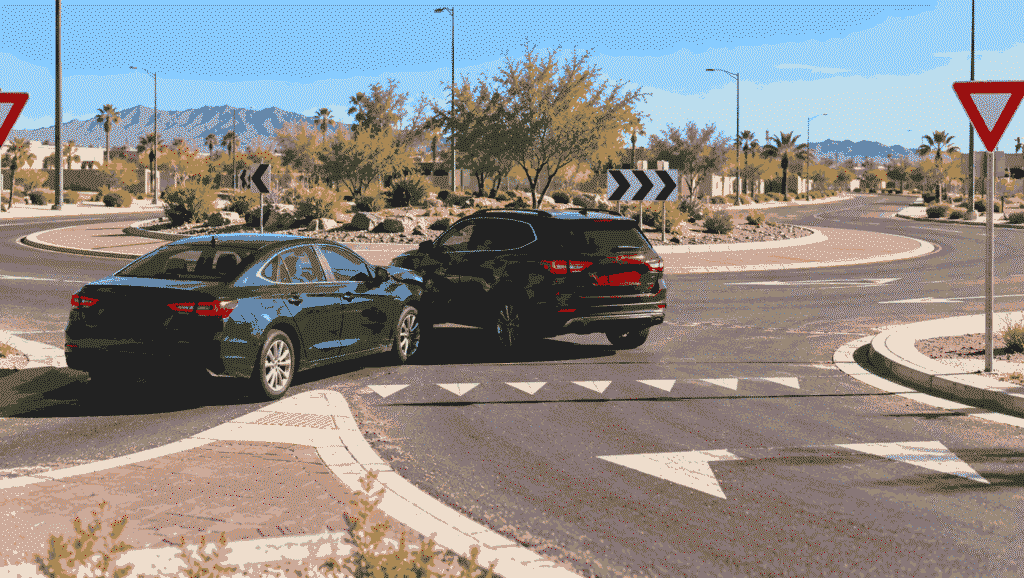
Who Has the Right of Way in a Nevada Roundabout?
Vehicles already circulating within a modern roundabout generally have priority over entering traffic.
Drivers approaching the roundabout should slow down, observe the posted traffic controls, and wait for a safe opening before entering.
Nevada’s NRS 484B.257 addresses the duties of drivers entering intersections controlled by stop or yield signs.
The statute requires drivers to yield to qualifying traffic already in or approaching the intersection.
Nevada law also addresses rotary traffic islands under NRS 484B.220, which requires vehicles passing around a rotary island to travel to its right.
The precise layout and posted controls remain important because roundabouts can differ in size and lane configuration.
Is the Driver Entering a Roundabout Always at Fault?
No.
Failing to yield when required can be strong evidence of negligence, but an entering driver is not automatically responsible for every collision.
For example, another driver may have made an unexpected lane movement or otherwise contributed to the crash.
The investigation may need to establish where each vehicle was traveling, whether the entering driver had a safe opportunity to proceed, and whether another driver’s conduct created an additional hazard.
A traffic violation may be relevant to the liability analysis, but responsibility should be determined from the complete circumstances.
What If Two Cars Collide in a Multi-Lane Roundabout?
Multi-lane roundabouts can create additional disputes about lane position and exiting.
NDOT advises drivers to choose the appropriate lane before entering a multi-lane roundabout.
The intended exit and posted lane markings help determine which lane should be used.
Nevada’s NRS 484B.223 generally requires vehicles on highways with multiple marked lanes traveling in the same direction to remain within a lane until an appropriately signaled movement can be made safely.
That requirement may become relevant when a driver crosses into another lane or moves toward an exit.
If two vehicles collide while circulating, investigators may need to determine whether either driver departed from the proper lane or attempted an unsafe maneuver.
What If a Driver Exits the Roundabout From the Wrong Lane?
An improper exit may create a collision hazard.
In a multi-lane roundabout, a driver may attempt to exit while another vehicle is traveling alongside them.
NDOT specifically cautions drivers not to exit from the inside lane when another vehicle is traveling to their right.
The department also advises drivers to use their turn signals when exiting.
Whether an exit maneuver was negligent depends on the roundabout’s configuration, posted lane directions, vehicle positions, and surrounding traffic.
An experienced personal injury attorney can investigate those details when a collision causes significant injuries.
What If a Driver Stops Suddenly Inside the Roundabout?
Stopping unexpectedly can create a dangerous situation, but fault is not automatic.
NDOT advises motorists already circulating within a roundabout not to stop merely to allow waiting vehicles to enter.
However, a driver may need to slow or stop because of a pedestrian, an emergency, or another immediate hazard.
If a rear-end collision occurs, investigators should consider why the leading vehicle stopped and whether the following driver maintained appropriate control and distance.
The fact that one vehicle struck another from behind does not necessarily resolve every liability question.
What If a Pedestrian Is Hit Near a Roundabout?
Pedestrian collisions require a separate examination of crosswalk and right-of-way rules.
Roundabouts commonly have pedestrian crossings near their entrances and exits.
NDOT advises drivers to yield to pedestrians and bicyclists when approaching roundabouts and to watch for people crossing near exits.
Nevada’s NRS 484B.283 addresses pedestrian right of way at qualifying crosswalks.
Hale’s guide to Nevada pedestrian right-of-way laws explains those rules in greater detail.
When a driver strikes a pedestrian near a roundabout, the investigation may need to consider the crossing location, visibility, vehicle movements, and applicable traffic controls.
Can Both Drivers Be at Fault for a Roundabout Accident?
Potentially.
Nevada follows a modified comparative-negligence system.
Under NRS 41.141, a claimant’s comparative negligence generally does not bar recovery when it is not greater than the negligence or combined negligence of the parties from whom recovery is sought.
When recovery is permitted, the claimant’s damages are reduced according to their percentage of negligence.
For example, one driver might enter without yielding while another makes an unsafe lane movement.
That does not mean both drivers necessarily share fault. Each alleged contribution must be supported by evidence.
What Evidence Matters After a Roundabout Collision?
The layout of the roundabout can be especially important.
Depending on the circumstances, useful evidence may include:
- Photographs showing the entrance and exit lanes
- Yield signs and directional arrows
- Lane markings
- Vehicle damage and final positions
- Dashcam or nearby surveillance footage
- Independent witness statements
- Police observations
- Information showing each driver’s intended exit
Do not put yourself in danger to document the roadway.
If injuries occur, prioritize safety and appropriate medical care.
Hale’s guide to what to do after a car accident in Las Vegas explains additional steps that may help preserve important accident information.
What If the Insurance Company Says You Were at Fault?
An insurer may reach an initial conclusion based on driver statements, vehicle damage, or the apparent direction of travel.
However, roundabout collisions can involve traffic rules that are unfamiliar to some drivers.
A proper investigation may require examining the intersection’s design and the movements of each vehicle.
If the insurer’s liability determination is disputed and significant injuries are involved, an experienced Nevada personal injury attorney can review the evidence and applicable law.
Legal advice may also be valuable before accepting a settlement or signing a release.
Understanding Responsibility After a Roundabout Accident in Nevada
A roundabout accident in Nevada may involve failure to yield, improper lane selection, unsafe exiting, or another traffic-related issue.
Drivers entering modern roundabouts generally must yield to circulating traffic, but the entire collision should be evaluated before assigning responsibility.
When injuries are significant or the drivers disagree about what happened, an experienced personal injury attorney can investigate the accident and help evaluate the available options.
If you were injured in a roundabout collision in Las Vegas, Henderson, or elsewhere in Nevada, Hale Injury Law can help you understand your legal options.
Every accident is different. This information is for general educational purposes and is not legal advice. Past results do not guarantee a similar outcome.
Frequently Asked Questions
Who has the right of way in a Nevada roundabout?
Vehicles already circulating within a modern roundabout generally have priority over entering traffic. Drivers must follow the applicable yield signs and other traffic controls.
Is the entering driver always responsible for a roundabout accident?
No. Failing to yield may be important evidence, but liability depends on the circumstances and conduct of the drivers involved.
Can you change lanes inside a roundabout?
Drivers must follow posted lane markings and applicable traffic rules. Nevada law generally requires lane movements to be signaled appropriately and made only when safe.
Can both drivers share fault after a roundabout collision?
Potentially. Nevada’s comparative-negligence law may apply when evidence supports negligence by more than one party.
What if a driver exits a roundabout from the wrong lane?
An improper exit may contribute to a collision. Determining responsibility requires examining the roundabout’s lane configuration and the vehicles’ movements.
