
A pedestrian accident in Arizona is not governed by a single rule that pedestrians always, or never, have the right of way.
Arizona law gives pedestrians important protections at crosswalks and requires drivers to exercise due care to avoid collisions with pedestrians. But pedestrians also have legal responsibilities, particularly when crossing somewhere other than a crosswalk.
After a serious pedestrian collision, determining fault requires looking at where the pedestrian was crossing, traffic signals, vehicle movement, visibility and the actions of everyone involved.
Table of Contents
Who Is at Fault in a Pedestrian Accident in Arizona?
Fault depends on the circumstances of the collision.
At a qualifying crosswalk without operating traffic signals, Arizona law generally requires drivers to yield to a pedestrian who is crossing on the driver’s half of the roadway or approaching closely enough from the opposite half to be in danger.
Outside a crosswalk, Arizona law generally requires the pedestrian to yield to vehicles on the roadway.
But neither rule should be considered in isolation. Arizona separately requires drivers to exercise due care to avoid colliding with pedestrians on any roadway.
That means the location of the pedestrian matters, but it may not be the only issue.
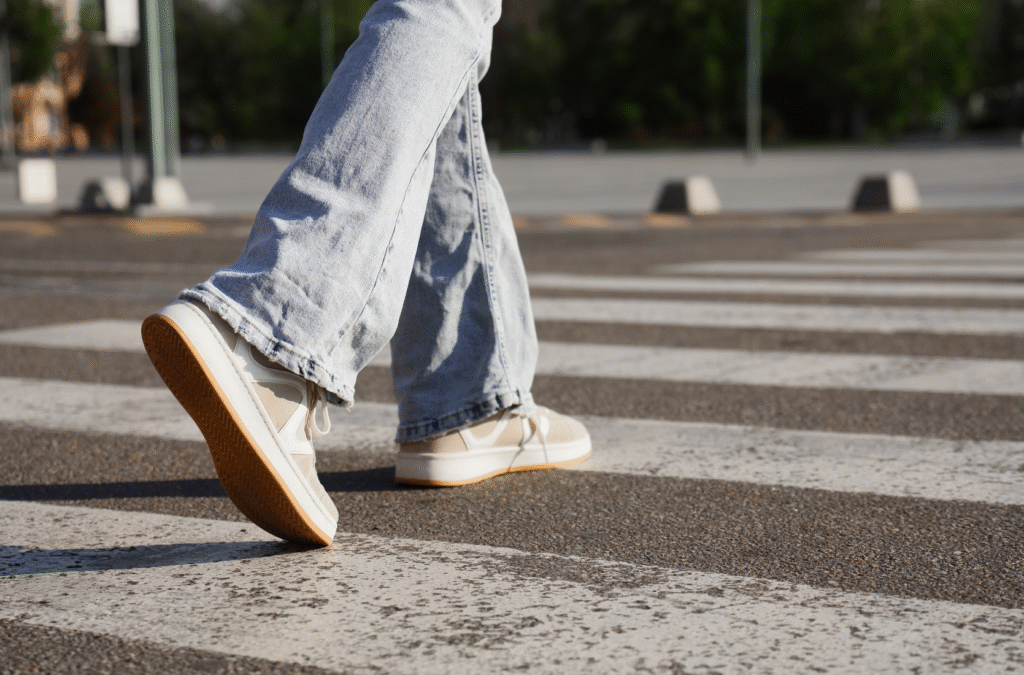
Do Pedestrians Have the Right of Way in Arizona Crosswalks?
In many situations, yes; however, Arizona’s statute contains important details.
Under A.R.S. § 28-792, when traffic-control signals are not in place or operating, a driver must yield, slowing or stopping if necessary, to a pedestrian crossing within a crosswalk when the pedestrian is on the driver’s half of the roadway or approaching closely enough from the opposite half to be in danger.
The statute also provides that a pedestrian may not suddenly leave a curb or other place of safety and enter the path of a vehicle that is so close the driver cannot yield.
Arizona law therefore places responsibilities on both road users even in a crosswalk situation.
What If a Car Stops for a Pedestrian in a Crosswalk?
Another driver generally cannot simply pass the stopped vehicle.
A.R.S. § 28-792 specifically provides that when a vehicle is stopped at a marked crosswalk, or an unmarked crosswalk at an intersection, to allow a pedestrian to cross, a driver approaching from behind may not overtake and pass the stopped vehicle.
That rule addresses a particularly dangerous situation: one vehicle recognizes the pedestrian and stops, while another driver attempts to pass without seeing why traffic stopped.
What If the Pedestrian Was Crossing Outside a Crosswalk?
Arizona law generally requires the pedestrian to yield.
Under A.R.S. § 28-793, a pedestrian crossing a roadway somewhere other than a marked crosswalk or an unmarked crosswalk at an intersection must yield the right of way to vehicles on the roadway.
The statute also generally prohibits pedestrians from crossing outside a marked crosswalk between adjacent intersections where traffic-control signals are operating.
But crossing outside a crosswalk does not mean a driver has permission to hit a pedestrian.
Do Arizona Drivers Still Have a Duty to Avoid a Pedestrian Outside a Crosswalk?
Yes.
A.R.S. § 28-794 requires every driver to exercise due care to avoid colliding with any pedestrian on any roadway.
The statute also requires a driver to give an audible warning when necessary and to exercise proper precaution when observing a child or a confused or incapacitated person on the roadway.
That is why a pedestrian’s failure to yield outside a crosswalk should not automatically end the liability analysis.
The investigation may still need to consider whether the driver was speeding, distracted, impaired, could see the pedestrian or had a reasonable opportunity to avoid the collision.
Can a Pedestrian Be Partly at Fault?
Potentially.
Arizona follows a pure comparative-negligence system.
Under A.R.S. § 12-2505, a claimant’s negligence generally does not completely bar a claim. Instead, recoverable damages can be reduced according to the claimant’s relative degree of fault, subject to the statute.
For example, evidence might support an argument that a pedestrian crossed outside a crosswalk without yielding while a driver was also speeding or failing to pay adequate attention.
That does not mean fault should automatically be divided in every pedestrian collision. Each person’s conduct must be evaluated from the evidence.
Hale’s guide to Arizona comparative negligence explains Arizona’s shared-fault system in more detail.
What If the Pedestrian Had a Walk Signal?
Traffic-control signals can materially affect the analysis.
Arizona pedestrians are subject to traffic-control signals at intersections under A.R.S. § 28-791.
When a pedestrian collision happens at a signalized Phoenix-area intersection, determining which signals were displayed can therefore become important.
Potential evidence may include:
- traffic-camera or nearby surveillance footage;
- dashcam video;
- witnesses;
- the intersection’s signal configuration;
- photographs;
- police observations; and
- the movements of turning vehicles.
If the drivers and pedestrian give conflicting accounts, preserving independent evidence quickly can be especially important.
What About a Pedestrian Hit by a Turning Vehicle?
Turning vehicles create another point of conflict between drivers and pedestrians.
A driver may be watching opposing traffic while preparing to turn and fail to notice someone entering or already occupying a crosswalk.
Whether the pedestrian had the right of way will depend on the intersection, traffic controls and circumstances, but Arizona’s general due-care requirement still applies.
A serious turning-vehicle pedestrian collision can warrant careful investigation of both the traffic signal and the driver’s opportunity to observe the pedestrian.
How Common Are Pedestrian Crashes in Arizona?
Pedestrian safety remains a significant statewide concern.
According to the Arizona Department of Transportation, Arizona recorded 1,999 pedestrian crashes in 2025.
ADOT also identifies vulnerable road users—including pedestrians and bicyclists—as a major emphasis area in Arizona’s statewide Strategic Highway Safety Plan.
Statewide crash numbers provide useful safety context, but they do not establish fault in an individual pedestrian accident.
What Evidence Matters After a Pedestrian Accident?
Evidence can be particularly important because a pedestrian does not have a vehicle surrounding them that preserves obvious impact damage in the same way two-car collisions often do.
Depending on the circumstances, relevant evidence may include:
- photographs and video from the scene;
- the location of the pedestrian and vehicle;
- crosswalk markings;
- traffic signals and signs;
- witness information;
- nearby surveillance footage;
- vehicle damage;
- skid marks or debris;
- police observations; and
- medical documentation.
If injuries are serious, an experienced personal injury attorney can investigate potential video and other evidence before it is lost or overwritten.
What If the Driver Says the Pedestrian “Came Out of Nowhere”?
That statement should be evaluated against the evidence.
Visibility can be affected by darkness, parked vehicles, roadway design, weather, lighting and other conditions.
But the investigation may also need to consider the driver’s speed, attention and opportunity to respond.
Arizona’s pedestrian statutes specifically address both situations: pedestrians may have duties concerning where and how they enter the roadway, while drivers retain a duty to exercise due care to avoid pedestrians.
A serious injury claim should not be resolved simply by accepting either party’s description without examining the surrounding evidence.
Why Can a Pedestrian Accident in Arizona Become Complicated?
Because pedestrian right of way changes with the circumstances.
A pedestrian accident in Arizona may involve a marked crosswalk, an unmarked crosswalk, a signalized intersection or a pedestrian crossing elsewhere on the roadway. Different statutory duties can apply in each situation.
Arizona also requires drivers to exercise due care to avoid pedestrians even when another pedestrian rule may apply.
When injuries are significant or fault is disputed, an experienced personal injury attorney can investigate the collision, preserve available evidence and evaluate how Arizona’s pedestrian and comparative-negligence laws apply.
If you were injured as a pedestrian in Phoenix or elsewhere in Arizona, Hale Injury Law can help you understand your options.
Every accident is different. This information is for general educational purposes and is not legal advice. Past results do not guarantee a similar outcome.
Frequently Asked Questions
Do pedestrians always have the right of way in Arizona?
No. Arizona’s rules depend on where and how the pedestrian is crossing. Drivers have important yielding duties at qualifying crosswalks, while pedestrians crossing elsewhere generally must yield to roadway traffic.
Can a pedestrian be at fault for crossing outside a crosswalk?
Potentially. Arizona law generally requires pedestrians crossing outside marked or unmarked intersection crosswalks to yield to vehicles. Arizona’s comparative-negligence rules may become relevant when evidence supports fault by both parties.
Does a driver still have to avoid someone crossing outside a crosswalk?
Yes. Arizona separately requires drivers to exercise due care to avoid colliding with any pedestrian on any roadway.
What if a pedestrian suddenly steps into traffic?
Arizona’s crosswalk statute provides that a pedestrian may not suddenly leave a curb or other place of safety and enter the path of a vehicle that is so close the driver cannot yield. The complete circumstances still need to be evaluated.
