
A parking lot accident in Nevada may happen at low speed, but determining fault is not always simple.
Drivers may be backing from neighboring spaces, moving through parking aisles, entering from a driveway or competing over who had the right of way. Video may exist but disappear quickly, and the fact that the crash happened on privately owned property does not necessarily mean Nevada’s crash laws are irrelevant.
If someone is injured or the drivers disagree about what happened, preserving evidence early can be particularly important.
Table of Contents
Who Is at Fault in a Parking Lot Accident in Nevada?
Fault depends on how the collision happened.
There is no rule that automatically makes the moving driver, backing driver or driver with more vehicle damage responsible for every parking-lot collision.
Instead, the investigation may consider which vehicles were moving, where they were positioned, whether one vehicle was entering from a private way, visible signs or markings, driver attention and other evidence showing how the crash occurred.
If both drivers contributed, Nevada’s comparative-negligence law may also become relevant.
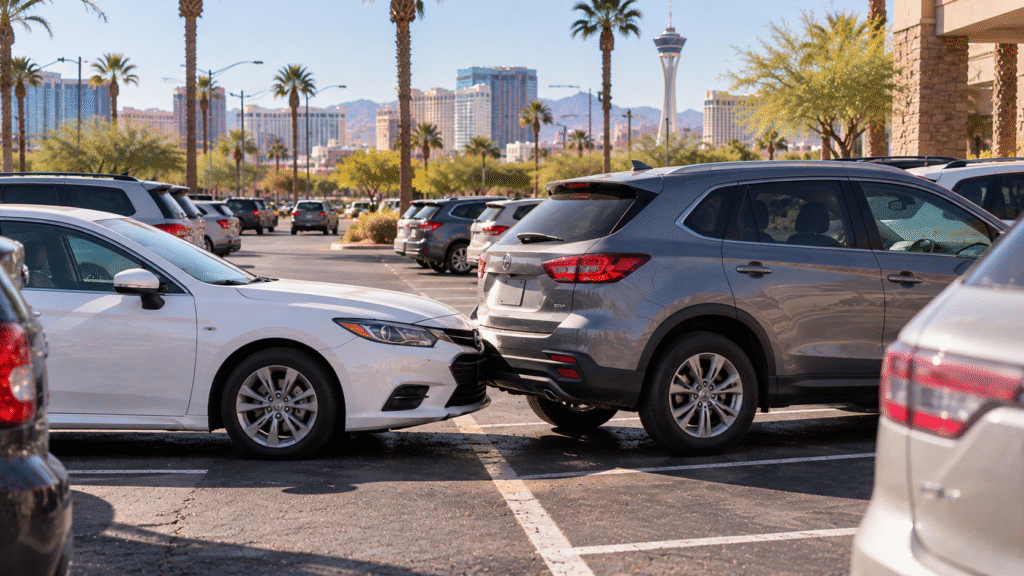
Do Nevada Traffic Laws Apply in Parking Lots?
Some Nevada traffic and crash laws expressly apply to publicly accessible parking areas.
NRS 484A.185 defines “premises to which the public has access” broadly and specifically includes parking decks, parking garages, parking structures and paved or unpaved parking lots where vehicles are parked or reasonably likely to be parked.
That definition matters because several provisions in Nevada’s crash-reporting chapter expressly apply to crashes occurring on a highway or premises to which the public has access.
So “it happened on private property” should not be treated as a blanket answer to whether Nevada law applies.
What Should You Do After a Parking Lot Accident?
Start with safety.
If anyone is injured, seek appropriate medical help. If vehicles are creating a hazard and can safely be moved, Nevada law contains specific requirements concerning moving vehicles after certain property-damage crashes.
Then document the scene before evidence changes.
Photograph:
- both vehicles and their damage;
- the entire parking aisle or driving area;
- parking-space lines and directional arrows;
- stop or yield signs;
- entrances and exits;
- nearby storefronts or structures that may have cameras; and
- anything obstructing either driver’s view.
Exchange driver and insurance information and identify witnesses before they leave.
Hale’s guide to what to do after a car accident in Las Vegas covers the broader evidence and medical-care steps that can help after a Nevada collision.
Do You Have to Stop After a Crash in a Parking Lot?
Yes, Nevada’s crash statutes can impose stop-and-information duties on publicly accessible parking premises.
Under NRS 484E.010, a driver involved in a crash on a highway or premises to which the public has access that results in bodily injury or death must stop and remain at the scene while fulfilling the statutory requirements.
NRS 484E.020 likewise addresses property-damage crashes on highways or premises to which the public has access.
And NRS 484E.030 sets out duties involving information and aid after qualifying crashes.
A parking-lot collision should therefore not be treated as something drivers can simply leave because the property itself is privately owned.
What If You Hit an Unattended Parked Car?
Nevada has a specific rule for that situation.
NRS 484E.040 applies when a driver damages an unattended vehicle or other property on a highway or premises to which the public has access.
The statute requires the driver to stop and either locate and notify the operator or owner or securely leave a conspicuous written notice containing the required identifying information.
That makes a hit-and-run involving a parked vehicle different from a collision in which both drivers are present.
Who Has the Right of Way When Leaving a Parking Lot?
Nevada law contains a specific rule when a vehicle enters a highway from a private way.
Under NRS 484B.260, a driver about to enter or cross a highway from a private way must yield the right of way to vehicles approaching on the highway.
That can become important when a collision happens at the point where a shopping center, casino, apartment complex or other parking area connects with a public road.
Inside the parking lot itself, however, liability may depend more heavily on the actual layout, signs, markings and movements of the vehicles.
Who Is at Fault When Two Cars Back Out at the Same Time?
Potentially either driver—or both.
Two vehicles backing from opposite spaces can create a situation in which both drivers had an opportunity to observe the other vehicle and avoid the collision.
Evidence becomes especially important because vehicle damage alone may not establish which vehicle began moving first.
Photographs, witnesses and surveillance video can help show the sequence.
Nevada’s comparative-negligence statute, NRS 41.141, provides that a plaintiff’s comparative negligence does not bar recovery when it is not greater than the negligence of the party or combined parties from whom recovery is sought. When recovery is permitted, the award is reduced according to the plaintiff’s share of negligence.
That is one reason an experienced personal injury attorney can be useful when both drivers insist the other caused the collision.
What If One Car Was Parked When It Was Hit?
A legally parked, stationary vehicle presents a different factual situation from two moving vehicles.
If your vehicle was stationary and occupied when another driver struck it, evidence showing that position may simplify part of the liability investigation.
But other issues can still be disputed, including whether an injury resulted from the collision and what insurance applies.
If the vehicle was unattended, Nevada’s rules concerning crashes with unattended property become especially important.
Can Store or Casino Surveillance Video Help?
Potentially, and it may be one of the most useful pieces of evidence in a disputed parking-lot collision.
Las Vegas-area parking lots and garages may be surrounded by businesses, casinos, apartment buildings or other properties with surveillance systems.
Whether useful footage exists—and how long it is retained—will depend on the property.
If injuries are significant or liability is disputed, asking a qualified personal injury attorney about evidence preservation can be worthwhile. An attorney can identify potential sources of video and take appropriate steps to seek preservation before footage is routinely overwritten.
Do not assume a business will retain video indefinitely simply because cameras were visible.
What If the Other Driver Leaves?
Prioritize identifying information if you can do so safely.
A license plate, vehicle description, photographs, witness information and surveillance footage may help identify a driver who leaves a parking-lot crash.
Do not chase or confront the vehicle.
Report the collision to the appropriate authorities and your insurer, and preserve the evidence you have.
If the driver cannot be identified or turns out to be uninsured, available insurance becomes a separate question. Do not assume a particular policy covers the loss without reviewing the actual coverage.
Why Can a Parking Lot Accident Claim Become Complicated?
Because parking lots combine vehicles moving in several directions with pedestrians, parked cars, private-property layouts and often limited visibility.
A parking lot accident in Nevada can also create misconceptions about which laws apply simply because the pavement is privately owned.
Current Nevada law expressly recognizes many publicly accessible parking lots and garages as premises to which the public has access, and important crash-scene duties can apply there.
When injuries are significant, both drivers blame each other, surveillance evidence may exist or insurance coverage becomes complicated, a qualified personal injury attorney can help investigate the collision before important evidence disappears.
If you were injured in a parking-lot collision in Las Vegas, Henderson or elsewhere in Southern Nevada, Hale Injury Law can help you understand your options.
Every accident is different. This information is for general educational purposes and is not legal advice. Past results do not guarantee a similar outcome.
Frequently Asked Questions
Do Nevada accident laws apply in private parking lots?
Some do. Nevada expressly defines publicly accessible parking lots, parking garages and similar areas as “premises to which the public has access,” and several crash statutes apply to accidents on those premises.
Who is at fault when two cars back out at the same time?
It depends on the evidence. Either or both drivers may have contributed, and Nevada’s comparative-negligence rules may become relevant.
Do I have to stop if I hit an empty parked car?
Yes. Nevada law imposes duties after damaging an unattended vehicle or other property on a highway or premises to which the public has access.
Should I ask a business for surveillance footage?
If the collision is disputed, identifying nearby cameras quickly can be useful. For a significant injury claim, an attorney can help determine appropriate evidence-preservation steps.
